



 Publication date: 02.02.2026
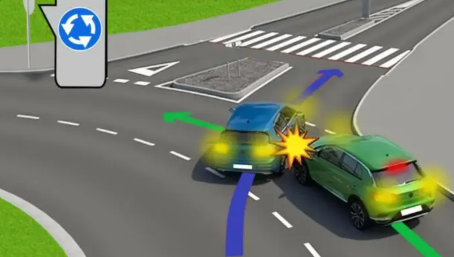
A fine for failure to yield is one of the most common administrative penalties in the field of road traffic in Poland. Such cases usually concern situations where a driver, according to the assessment of the police or municipal service, did not let another road user pass and created a potential danger. In this case, a sanction can be imposed even without an actual collision — a subjective conclusion of “coercion to yield” is enough.

In practice, a significant part of such fines raises reasonable doubts. The reasons are complex traffic organization, unclear priority signs, erased markings or different interpretations of the situation by its participants. That is why a dispute over priority at a road intersection often requires a deeper legal analysis than a standard assessment by a patrol officer.
Theoretical principles: what is considered failure to yield
From the point of view of Polish law, failure to yield means a violation of the established traffic order, in which one participant must let another pass in accordance with signs, signals or general rules. This may apply not only to intersections, but also to exiting a secondary road, merging into traffic, reversing or situations involving pedestrians and cyclists.

The key point is not the fact of movement itself, but the assessment of whether the other participant was forced to change speed or direction. This is where the greatest number of controversial points arise, because the decision is often based not on objective measurements, but on assumptions.
Typical situations in which disputes arise
In practice, a fine for failure to give way is most often imposed in the following cases:
- intersections with combined signs and markings;
- poor visibility of signs due to weather conditions or infrastructure;
- simultaneous movement of several vehicles;
- different interpretations of the moment of danger;
- lack of clear recording of the event.
In each of these situations, evidence in the case of failure to give way is of decisive importance, and not just a formal protocol.
Is a fine always legal?
Not every fine is ultimately justified. An appeal against a fine for forcing to yield is possible if:
- there is no video or photo evidence;
- road signs were invisible or contradictory;
- another participant violated the rules themselves;
- the reconstruction of the event was incomplete or inaccurate;
- the conclusions are based solely on a subjective assessment.
In such cases, even minor inaccuracies can significantly affect the legal assessment.
Practice: how a lawyer helps in disputes about the right of way
Legal assistance in disputes regarding the right of way does not only consist of filing an appeal. The lawyer conducts a comprehensive analysis of the entire situation, including:
- checks the organization of traffic at the scene of the incident;
- analyzes the diagrams, markings and road signs;
- evaluates the protocols and explanations of the parties;
- works with video recordings and witness testimonies;
- forms a reasoned legal position;
- represents the client's interests before the authorities or the court.
This approach allows you to objectively assess whether a violation actually occurred or whether the fine was imposed formally.
Why it is important to act quickly
In cases of failure to give way, time is of the essence. Delay can lead to the loss of video recordings, the inability to interrogate witnesses, or the missing of appeal deadlines. That is why timely legal assistance in disputes regarding the right of way significantly increases the chances of protection.
A fine for failure to yield in traffic is not always indisputably legal. Its legality depends on the specific circumstances, the quality of the evidence, and the correctness of the assessment of the traffic situation. Many cases that seem obvious at first glance turn out to be controversial upon detailed analysis. If you are faced with a dispute over priority at a road intersection or have received a fine and have doubts about its validity, contact Consultant Legal Marketplace. Our specialists will analyze your situation, assess the prospects for protection and help you build a correct legal position in accordance with Polish law.
Question
Can a fine for failure to yield without an accident be appealed?
Answer
Yes, if there is no objective evidence of creating a danger.
Question
Are the words of the other driver enough to impose a fine?
Answer
No, a proper evidentiary base is required.
Question
Is the condition of road signs and markings taken into account?
Answer
Yes, this is one of the key assessment factors.
Question
Is the presence of a lawyer mandatory?
Answer
No, but it significantly increases the effectiveness of the defense.
Question
Is it possible to cancel a fine if the inspector did not record the violation on video?
Answer
Yes, the absence of video evidence may be grounds for canceling the fine due to insufficient proof.